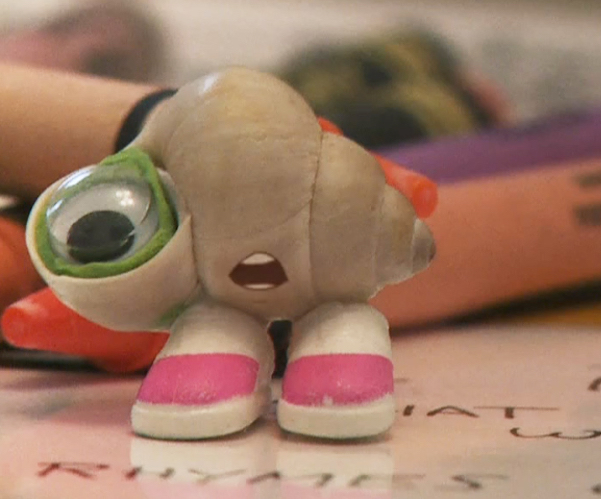
It’s high time we posted about a favorite of ours here at What Is Metamodern? – the remarkable and thoroughly metamodern movie, Marcel the Shell with Shoes On (Dean Fleischer Camp, 2022*). Coincidentally (or not!), my first exposure to this movie was in a trailer before the film Everything Everywhere All at Once. EEAAO is frequently lauded as a metamodern tour de force, remarkable for braiding together a science-fictiony exploration of the multi-verse concept with a very this-world-based emotional story of family conflict and reconciliation – interspersed with wacky scenes about people with hot dog fingers (!!!). Meanwhile, as I learned in the preview, Marcel is about a walking, talking seashell and his grandmother (also a shell) who have been discovered by a male human who is Air-BnB-ing in the house Marcel lives in. Before EEAAO even began, I knew I’d be returning to the theater soon for Marcel.
I’ve now come to view these two films as a potent pair that define an axis of metamodernism arguably shaped by the production company that put both out – A24. There’s a lot to say about A24 that will have to wait for another post; and we’ve already devoted a post here on What Is Metamodern? to EEAAO. Suffice it to say that though not all of A24’s films and television shows exhibit metamodern sensibilities, a notable portion of them do, and the two films that were juxtaposed on my local cinema screen are prime examples of two rather different flavors of the metamodern: EEAAO’s metamodernism is trippy and veers towards the psychologically dark and sometimes scary corners of the this-is-your-brain-on-family dynamics, flip-flopping at times to the wacky and warm-hearted. Whereas Marcel’s metamodernism is quirky and precious and poignant, even as it dips a couple toes into heavier, existential material like aging and dying. I’ll focus here on some metamodern qualities that I feel Marcel embodies: oscillation, meta-cute, metamodern autofiction and overprojection.
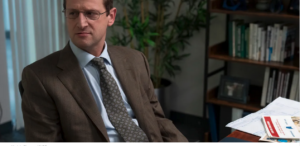
Using the format of the faux documentary, MTSWSO tells the story of Marcel’s life with his grandmother Connie (voiced by Isabella Rossellini) and his search for other family members from whom he’s been separated. Worldbuilding is woven into the narrative as Marcel shyly shows off his inventive uses of tiny human household items and detritus. For example a tennis ball into which he has cut an entry hatch serves as a sort of rolling vehicle to help him move faster around the house. A dried macaroni noodle becomes a shofar-like horn. Cotton balls are for Marcel and his grandmother to recline on. More on these micro-artifacts shortly. Another plot line is Connie’s tenuous mental health and physical frailty. Also, in an intertextual moment, Dean and Marcel find out that the television show 60 Minutes has expressed interest in the life story of this little shell.
With such an unusual premise, one might wonder what inspired this quirky film. This movie’s origin is indeed noteworthy. Marcel is a follow-up to a series of three shorts produced and released between 2010 and 2014 on of Youtube, where weird-for-the-sake-of-weird always has a home. A subtext in Marcel that gradually becomes less submerged is the heartbreak of Dean’s divorce. In a parallel to the reality outside the film, the real Dean Fleischer Camp and his ex-wife Jenny Slate – the actor and comedian who voices Marcel – ended their marriage between the making of the original Youtube shorts and the making of the feature film. Which brings up one of the metamodern aspects of the movie: autofiction.
A quick definition of autofiction in literary fiction: novels in which the main character has the same name as the author and shares biographical details with the author, and yet the narrative in the novel deviates from reality significantly. So, a little bit memoir, a little bit fiction. Although autofiction is frequently associated with postmodernism, the scholar Alison Gibbons observed the development of a category of autofiction that appears to be more metamodern: Instead of just playing fact vs. fiction games in order to introduce generalized speculations about the falsity of all narratives, metamodern autofiction uses the device to bring readers deeper into the felt experience of the author, rather than to make readers suspicious of such.**
In Marcel, the main biographical details shared between Dean, the film’s creator and Dean, the main character, are that both are filmmakers and are in the throes of recent divorce. The film becomes a way, then, for (the real) Dean to express the grief and healing in the dissolution of his actual marriage, while expressing the sense of displacement even more vividly through the made-up off-centered oddity of the talking-shell phenomenon. So the autofiction device here does seem metamodern rather than postmodern.
One of my recent viewings of Marcel took place with a group of people at a metamodern movie night. In the middle of it, one participant’s ten-year-old son who watched with us asked, “Wait, is this a documentary?” It seems hard to imagine that a kid that age genuinely believed that a tiny shell might be capable of speech, but perhaps there was something in the film’s extremely earnest commitment to the bit, in its affective authenticity, that made this boy have a hard time relegating it to the category of make believe.
It was also interesting that, among the participants in the movie night, some were certain that Marcel’s age is meant to be that of a child, while others were equally sure that Marcel is an early-20s adult. Marcel (the character) effervesces with a youthful, unguarded naivete. At the same time, Marcel (the film) treats very adult themes such as divorce, dementia, separation from family, and philosophical explorations of the ontology of objects. So it’s maybe not surprising that viewers vary in their reading of the talking shell’s age. I see this ambiguity as indicative of the film’s meta-cute sensibility: It has child-like vibes, but it’s meant for adults.
And speaking of objects and ontology: In my book, Say Hello to Metamodernism!, I named anthropomorphization/over-projection as one of 11 metamodern aesthetic methods. The idea is that a metamodern artwork protects the significance of individual interiority by going even further and projecting it into inanimate objects. One could say that this is what “animates” (metaphorically; and pardon the pun) Marcel and his other shell family members. Along with this obvious anthropomorphization, the film also does something that’s similar but more subtle: it brings us into the intimacy of small objects. Close-up camera work reveals the suchness of this tiny world. We observe the physics and seeming agency of not only the objects Marcel has made functional but other stuff as well: various dead leaves, pieces of lint, marbles, coffee filters and the like that form the landscape of his world. Though not sentient, each of these has its characteristic ways that it moves and exists.
To me, this brings to mind Object Oriented Ontology, a relatively recently developed philosophy that some have suggested is part of the overall metamodern cultural shift. OOO emphasizes objects as the focus of its effort to understand reality, rather than people, language and context, on the one hand, or the fundamental particles and forces of physics, on the other. In my book I argue that it is this emphasis that locates OOO as a metamodern philosophy in that it defends the suchness of objects against the postmodern tendency to relativize everything, and against the modernist tendency to reduce everything with some sort of explanation about “what’s really going on.” As lighthearted as the movie may seem, I feel that this sort of philosophical encounter with objects is a major part of what makes it so compelling.
Returning to the idea that the two A24 films, Marcel and EEAAO, released in the same year, are in a sense “metamodern inverses” of each other… Again, EEAAO is a philosophical film centered around parallel universes and nihilistic metaphysics that also has a silly side and a profoundly warm human side. MTSWSO with its quirky, silly premise, becomes a richly human film that also covertly explores abstract philosophical questions. While some fans of each film may be unmoved by the other, those who are drawn to the metamodern sensibility are likely to experience them as threads in the same web of metamodern aesthetic culture, and charming works of cinema in their own right.
In the words of Marcel:
“Every shell has a story to tell, you just have to listen closely.”
________
*Marcel the Shell With Shoes On is often listed with a release year of 2021, because it showed in festivals that year, but its wide theatrical release was in 2022.
**Gibbons, A. (2017) “Contemporary Autofiction and Metamodern Affect” in van den Akker, R., Gibbons, A., and Vermeulen, T. (eds) Metamodernism: Historicity, Affect, and Depth after Postmodernism, London; New York: Rowman & Littlefield International, pp.117-130.