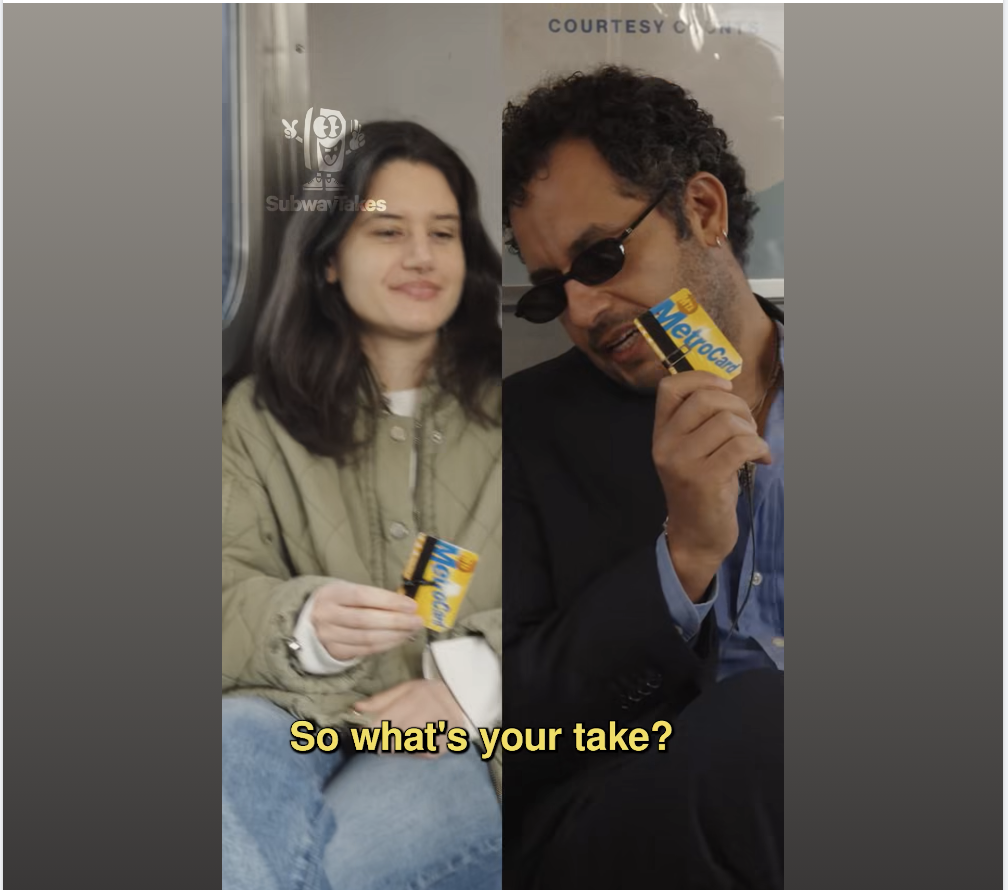
In the New York City subway, somewhere between Canal Street and Union Square, comedian Kareem Rahma holds up a microphone clipped to a MetroCard and asks someone an open-ended question: “So, what’s your take?”
His conversation partner might be Cate Blanchett, whose “take” is that leaf blowers should be eradicated from the face of the Earth. Or it might be Lil Nas X arguing that couples should have separate beds. Another day it’s a random non-celebrity subway rider who answers the prompt with “People should not be allowed to comment on videos unless they’ve watched the entire thing.”
What transpires in these roughly 90-second encounters is surprisingly captivating, with Kareem and his interviewee bouncing between self-mocking goofiness and earnest exploration of the human condition, highlighting the felt experience of both participants in the conversation inspired by whatever topic the guest happens to have chosen. Watching these Subway Takes, I get a sense of seeing a mini-master class in the metamodern sensibility, which I’ll talk about below.
Absurdity Meets Authenticity
Subway Takes, which Rahma co-created with Andrew Kuo and launched in 2023, follows a deceptively simple format. Rahma boards a subway car with at least two camera operators, engages a guest, and asks them to defend an opinion that’s usually either absurdly trivial or surprisingly profound. The MetroCard microphone is simultaneously functional and ridiculous, professional and makeshift. It’s a sight gag that becomes normalized within seconds, and serves as an invitation to both his guests and his viewers to join him in his self-aware, self-serious silliness. Though Subway Takes originally gained traction on the New York subway, Kareem has since brought the series to the urban transit systems of Chicago, London, Berlin and Paris.
One of Subway Takes’ notably metamodern qualities is its ability to draw genuine insight from seemingly silly premises. When guests defend takes like “Salad is meant to be eaten with your hands” or “Reading is overrated,” something unexpected happens. Through Rahma’s off-the-cuff but engaged, curious questioning, these absurd positions become windows into how people think, what they value, and how they navigate disagreement.
This is the metamodern sensibility in action: the refusal to dismiss the trivial as merely trivial, or to treat the profound as only profound. A conversation about eating salad with your hands can reveal someone’s relationship with social norms, their relationship with messiness, their philosophy about pleasure and efficiency. The show treats these moments with just enough seriousness to extract meaning, while maintaining enough playfulness to avoid pretension.
Conversely, when interlocutors introduce topics that one might expect to prompt Hallmark-card earnestness (for example, an inquiry such as “Are all people good?”), Rahma introduces humor and provocations that reveal his guests’ playful sides. This oscillation prevents the show from calcifying into either pure irony or pure sincerity. As Rahma himself has said, after making over 500 episodes, he seems to have created “a place where you can have a good time arguing.”
Democratizing Celebrity
The show’s guest list embodies another metamodern tension: the simultaneous embrace and critique of celebrity culture. Subway Takes features well-known figures such as Zohran Mamdani, Zoë Kravitz, Ira Glass, Charli xcx and Ethan Hawke, alongside bartenders, students, white-collar corporate types and other random commuters. This democratic approach doesn’t simply “humanize” celebrities by showing them engaging with everyday concerns; it also elevates everyday people by treating their opinions with the same seriousness afforded to famous guests.
The result is a subtle commentary on status and authenticity. When an A-list actor and a construction worker both defend their takes with equal conviction on the same platform, using the same absurd MetroCard microphone while bumping along a gritty train track, something shifts in how we perceive both. The celebrities seem more relatable not because they’re “slumming it” on the subway, but because the format refuses to treat their takes as inherently more valuable. Meanwhile, regular New Yorkers are granted the visibility and platform typically reserved for the famous, suggesting that interesting perspectives aren’t the exclusive domain of the recognized and successful.
The Performed Kareem: “Rack It Up 20%”
Rahma’s on-screen persona represents another interesting metamodern move. He is simultaneously himself and a caricature of himself. His comedic instincts are put to use in expressing many sides of his personality – earnest, silly, flirtatious, thoughtful, goofy – while maintaining a light ironic distance that signals his awareness of performing “Kareem Rahma, host of Subway Takes.”
Like the MetroCard microphone, Kareem’s trademark sunglasses are employed as a goofy prop, escalating the sense of performance woven into Subway Takes. At the same time, with the sunglasses establishing a certain affective distance as the baseline vibe of the series, Kareem’s occasional removal of them becomes a gesture of vulnerability. Similarly, his exaggeratedly emphatic declarations of “100% DISAGREE” or “100% AGREE” in reaction to featured takes become a self-conscious trademark of the Kareem Rahma character – one that also provides a trigger for the guests to throw themselves into their own playful self-exaggerations. They will often display a surprising level of self-satisfaction when Kareem agrees with their take or conversely an entertainingly playful “antagonism” when he opposes their position.
In interviews, Rahma notes that his on-screen persona is “who I am … [but] rack it up 20 percent.” Admitting that doesn’t undermine the authenticity of his presentation. Instead, it acknowledges what we already intuit: that all public personas involve some degree of performance. By being transparent about this performance, Rahma creates a different kind of authenticity – one that doesn’t pretend the camera isn’t there, but also doesn’t let that awareness prevent genuine connection.
Navigating Identity Without Identity Politics
The guests on Subway Takes are often Muslim (as identified either by themselves or Rahma) and will often bond with Rahma – who was born in Cairo but moved with his family to Minnesota when he was three years old – over their shared cultural background. However, the aspects of Muslim culture that are brought up tend to be its quirks and foibles – the details that the conversants find humorous. By more fully revealing the interiority of Muslim people, this metamodern comedic approach perhaps is a better way of normalizing Muslim culture to non-Muslim viewers than a strictly laudatory tone would be.
Similarly, Rahma frequently supports strong pro-feminist stances (examples: TikTok Episode 617, “There should be birth control for men and people who produce sperm” and TikTok Episode 621, “Companies should allocate two days a month for women to have period leave” to which Kareem declares, “100% AGREE!”) while also being unapologetic about his own “dude-like” qualities and perspectives. In doing so, he shows that men don’t have to abandon their own interiority while advocating for the rights and needs of women. Meanwhile, as a comedian, Kareem brings a tone to these conversations that tends to keep any sort of “battle of the sexes” kind of impulse from feeling overbearing.
The Practice of Productive Disagreement
Perhaps Subway Takes‘ most valuable metamodern quality is its modeling of how disagreement can be both real and enjoyable. Rahma has said his “ideal night is four hours at a table arguing and conversing with a group of five people. Debating about nothing, no one getting offended, because it’s for fun.” The show enacts this ideal in compact form.
When Rahma disagrees with a guest’s take, he does so unabashedly and energetically. But the format’s brevity and the shared understanding that these are takes rather than deeply held convictions create a container where disagreement doesn’t escalate into enmity. In some cases, we even witness Rahma genuinely change his opinion, modeling intellectual flexibility.
This is metamodernism’s answer to both postmodern ideological ambivalence and modernist certainty: the possibility of holding positions strongly enough to defend them, while remaining open enough to abandon them. It suggests that opinions can be both meaningful and provisional, that we can disagree about trivial things seriously and serious things trivially, and that the quality of a conversation matters more than the importance of its subject matter. Most importantly from a metamodern perspective, regardless of whether Kareem ultimately agrees or disagrees with his guests, he always appears to take delight in their thought processes and in everything else they reveal about themselves while defending their takes.
The Metamodern Moment
Subway Takes arrives during this cultural moment’s readiness to move on from both cynical detachment and performative earnestness. Irony that’s used as a shield against genuine engagement can become exhausting, but so can sincerity that demands we take everything with humorless seriousness. Rahma’s Subway Takes offers that metamodern third way: the possibility of caring about things lightly and joking about things sincerely.
The show’s success – with over 2 million followers across Instagram, Facebook, YouTube and Tiktok – suggests a hunger for this approach. Based on numbers of views, viewers seem to be equally enthusiastic about listening to the arguments of Ethan Hawke or a random subway rider because it affirms something we intuit: that the line between profound and trivial, between celebrity and nobody, between serious and playful, is far more permeable than our cultural categories suggest. In a MetroCard microphone clipped together with what we can only assume is optimism and hot glue, in a host who is simultaneously playing himself and being himself, in takes that are both jokes and genuine opinions, Subway Takes has found a frequency that resonates today – riding the rails between Canal and Union Square, somewhere between irony and earnestness, arguing about nothing and everything (all) at once.